How to play Mus
Mus — Bluff in pairs with secret signs. A classic from Spain.
Play Mus
Learn it with the coach, then play people from Spain. Part of the Spain journey.
Play MusLearn with the coachThe goal
Play in pairs and win points in four lances: Grande (the highest cards), Chica (the lowest), Pares (pairs) and Juego (31 or more points). In each lance you can pass, bet, raise or call Órdago — the whole match. The first pair to the target wins.
The deck
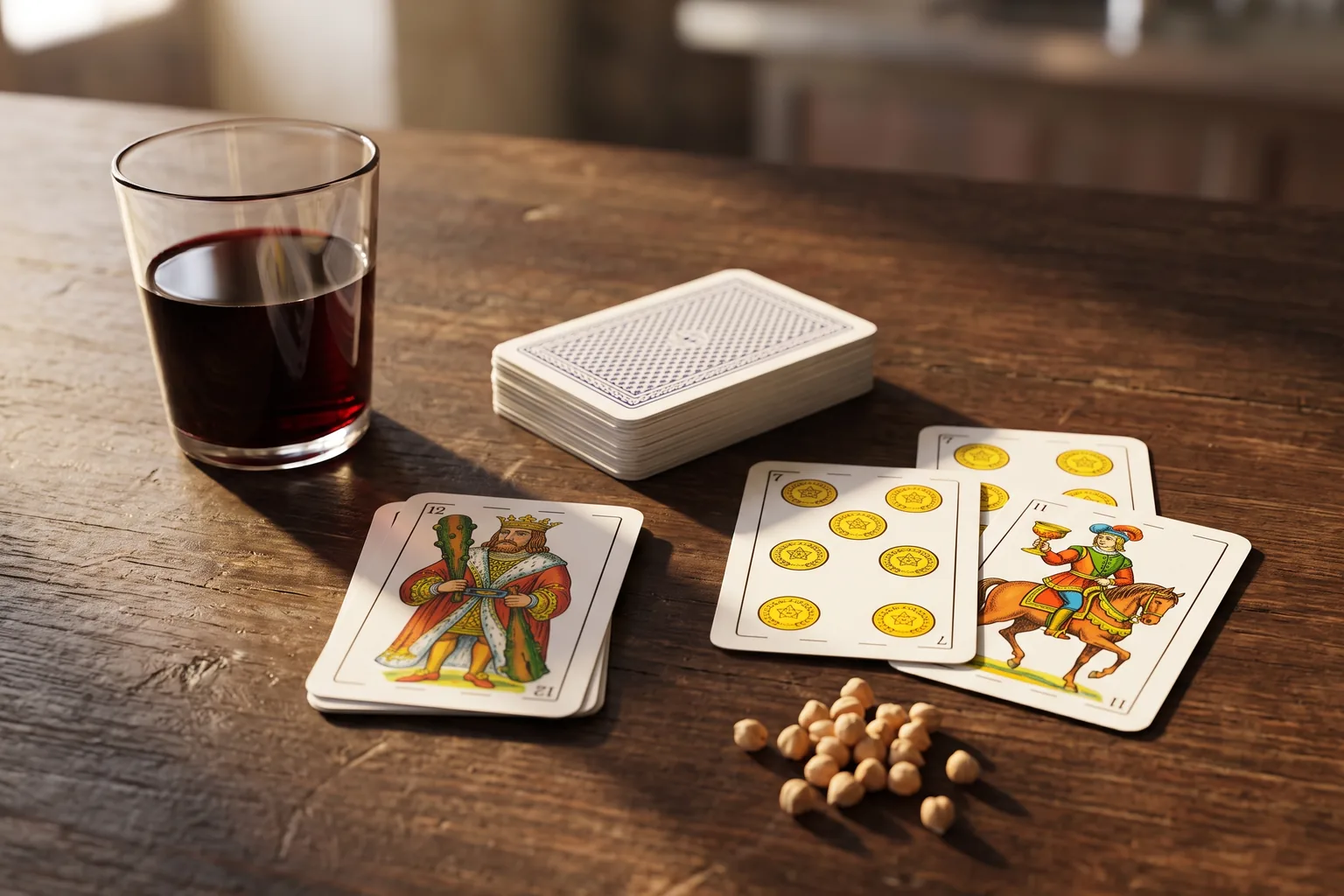
The 40-card Spanish deck. In Mus every 3 counts as a Rey and every 2 as an As. From high to low: Rey (and 3), Caballo, Sota, 7, 6, 5, 4, As (and 2). For Juego, figures and 3s are worth 10, Ases and 2s 1, the rest their number.
Setup
- 1Four players in two pairs; partners sit opposite. You play with Lucía.
- 2Deal 4 cards each. The player after the dealer is "mano" — they speak first and win every tie.
- 3Mus: from mano, each player says "Mus" (I want to change cards) or "No hay mus". If all four say Mus, everyone discards 1 to 4 cards and draws new ones, and you ask again — at most three times.
A turn
- 1Grande: the highest cards win, compared from the top card down.
- 2Chica: the lowest cards win, compared from the bottom up.
- 3Pares: only players with a pair take part. Par (a pair) < Medias (three of a kind) < Duples (two pairs).
- 4Juego: only players with 31 or more take part. Best is 31, then 32, 40, 37, 36, 35, 34, 33. If nobody has Juego, play Punto: the highest total up to 30 wins.
- 5Betting, from mano: "Paso" (pass), "Envido" (bet 2) or "Órdago" (the whole match). The other pair answers "Quiero" (accept), "No quiero" (refuse), "Envido 2 más" (raise) or "Órdago".
- 6"No quiero" gives the betting pair 1 point — or the last bet that had been accepted — straight away.
- 7Pares and Juego are only bet when both pairs have someone taking part.
- 8At the end, everyone shows their cards and the lances are paid in order.
Scoring
The first pair to 30 points (or 40) wins. At the end of a deal the lances are paid in order — Grande, Chica, Pares, Juego — and the first pair to reach the target wins on the spot. An accepted Órdago ends the match at once.
Questions
What's simplified here?
We skip the señas — the famous secret signals between partners (biting your lip for two Reyes, winking for 31) — because bots can't wink. Points are counted as plain points, without amarracos, piedras or vacas. Every mus round lets each player change 1 to 4 cards, and there are at most three rounds.
Why do 3s count as Reyes?
In the classic 8-Reyes Mus, 3s are Reyes and 2s are Ases. It makes strong hands more common and the game livelier.
Who wins a tie?
The player closer to mano — the one who speaks first.
Is there money involved?
No — bets are only game points. The first pair to the target wins.