How to play Chinchón
Chinchón — The family-lunch classic. A classic from Spain.
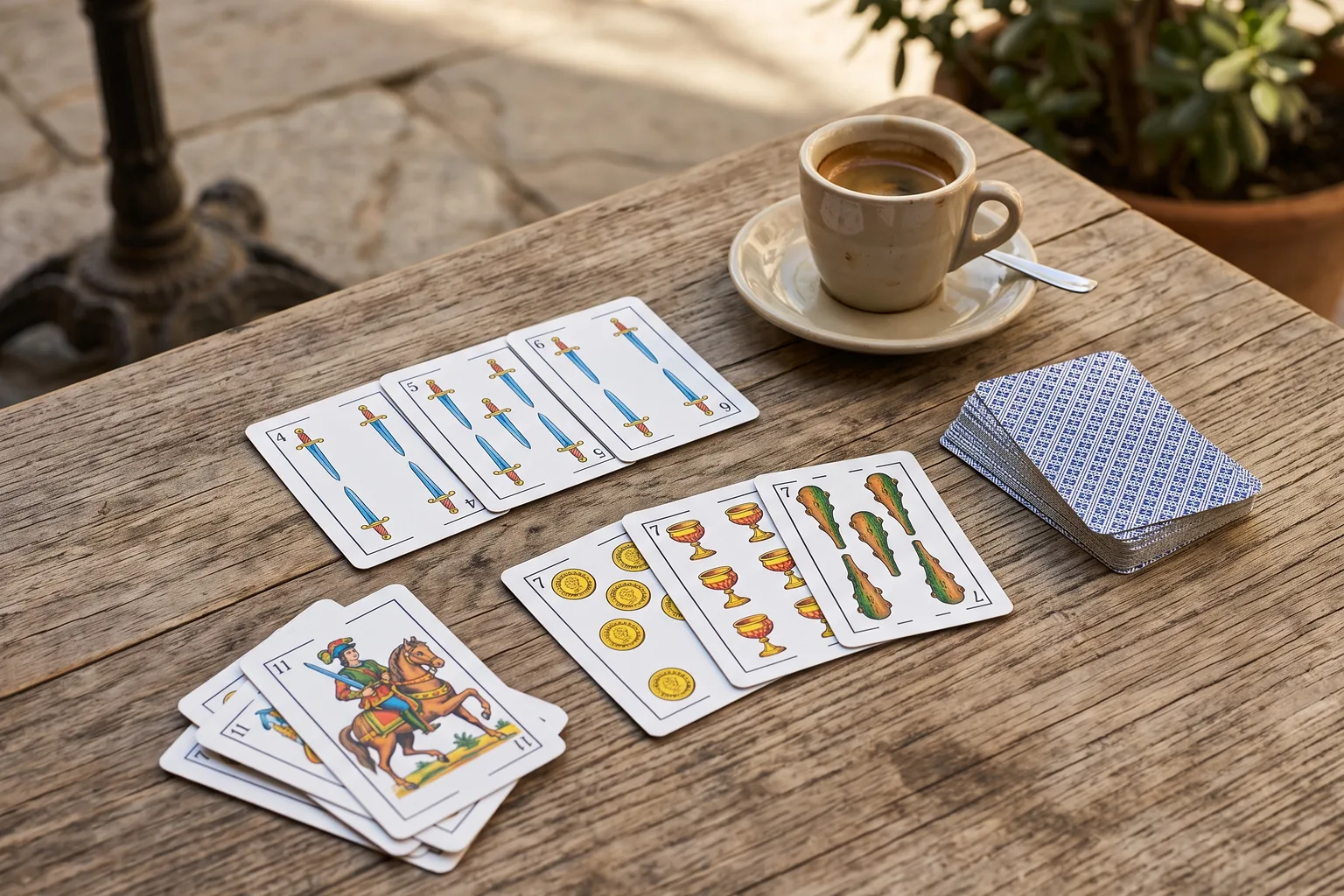
Play Chinchón
Learn it with the coach, then play people from Spain. Part of the Spain journey.
Play ChinchónLearn with the coachThe goal
Arrange your seven cards into melds — groups of the same rank or runs in one suit — so that the cards left over (your loose cards) are worth as little as possible. Close the round when you can, and don't go over the points limit.
The deck
The 40-card Spanish deck without jokers. Loose cards count their face value, 1 to 7; Sota, Caballo and Rey count 10 each. In a run the order is 1, 2, 3, 4, 5, 6, 7, Sota, Caballo, Rey.
Setup
- 1Deal 7 cards to each player.
- 2Turn the next card face up to start the discard pile; the rest is the deck.
- 3The player who didn't deal starts.
A turn
- 1Draw one card: the top card of the deck, or the top card of the discard pile.
- 2Discard one card face up.
- 3Melds are 3 or 4 cards of the same rank, or 3 or more cards of one suit in a row (a card belongs to one meld only).
- 4If your loose cards would total 5 points or less after discarding, you may close the round instead: your best discard is made for you.
- 5If the deck runs out, the discard pile (except its top card) is shuffled into a new deck.
Scoring
Scores add up round after round. The first player to go over the limit (50 or 100 points) loses and the other player wins. A Chinchón wins at once.
Questions
Can I close with one loose card?
Yes, as long as your loose cards total 5 points or less after your discard. With no loose cards at all you score −10.
Can my opponent add cards to my melds when I close?
In many Spanish homes they can. This version keeps it simple: each player only counts their own best arrangement.
What if nobody closes?
The discard pile is reshuffled into a new deck. In this version, if the deck runs out a third time — or after 80 turns — the round ends and both players add their loose points.
Are there jokers?
Some players add two comodines (jokers) as wild cards. This version plays without them, and there's no 'reenganche' (buying back in after going over).